

On September 19, 2026, at Homies B2, the University of Languages and International Studies – Vietnam National University, the seminar “Teaching English for a Sustainable Future: Starting from the Classroom” took place in a lively, open, and highly practical atmosphere.

The event not only broadened perspectives on “sustainability” but also offered practical suggestions and tools to help teachers bring real-life and global issues into the English classroom in a natural, meaningful way that aligns with the goal of developing learners’ competencies.
Attending the event were Dr. Hoa Ngoc Son – Vice President of the University of Languages and International Studies, VNU; Ms. Nguyen Thi Lan Huong – Deputy Head of the Office of Science, Technology and Development Cooperation, who also chaired and coordinated the seminar activities under the ULIS Connect educational support channel; along with staff, lecturers, teachers, and learners interested in English teaching and education for sustainable development.
Speaking at the event, Dr. Hoa Ngoc Son emphasized the importance of connecting foreign language teaching and learning with real-world social issues and new educational requirements. Integrating sustainable development content into the classroom not only helps make language learning more relatable and meaningful but also opens up opportunities for learners to develop their thinking, collaboration skills, sense of responsibility, and ability to actively participate in the community.
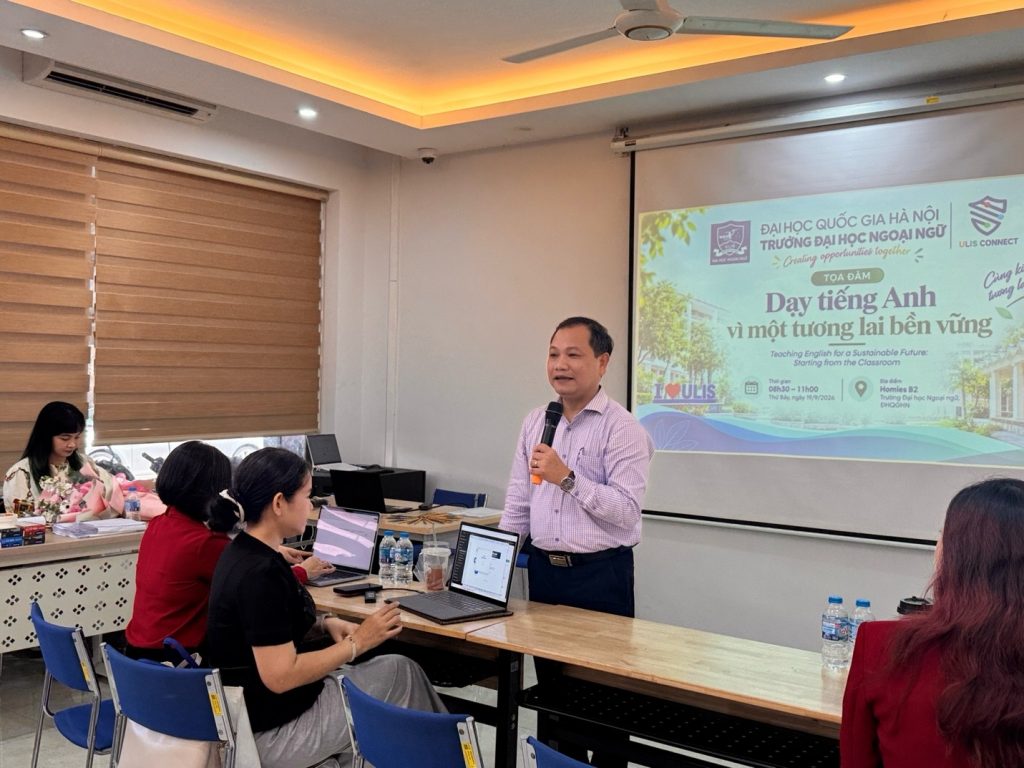
On behalf of the University, Dr. Hoa Ngoc Son presented flowers to the speakers, expressed his thanks, and wished the event success. The presence and support of representatives from the Board of Management, the Office of Science, Technology and Development Cooperation, the Faculty of English Language and Culture, and ULIS Connect also demonstrated the University's interest in professional networking, sharing best practices, and spreading meaningful educational approaches to the teaching community.
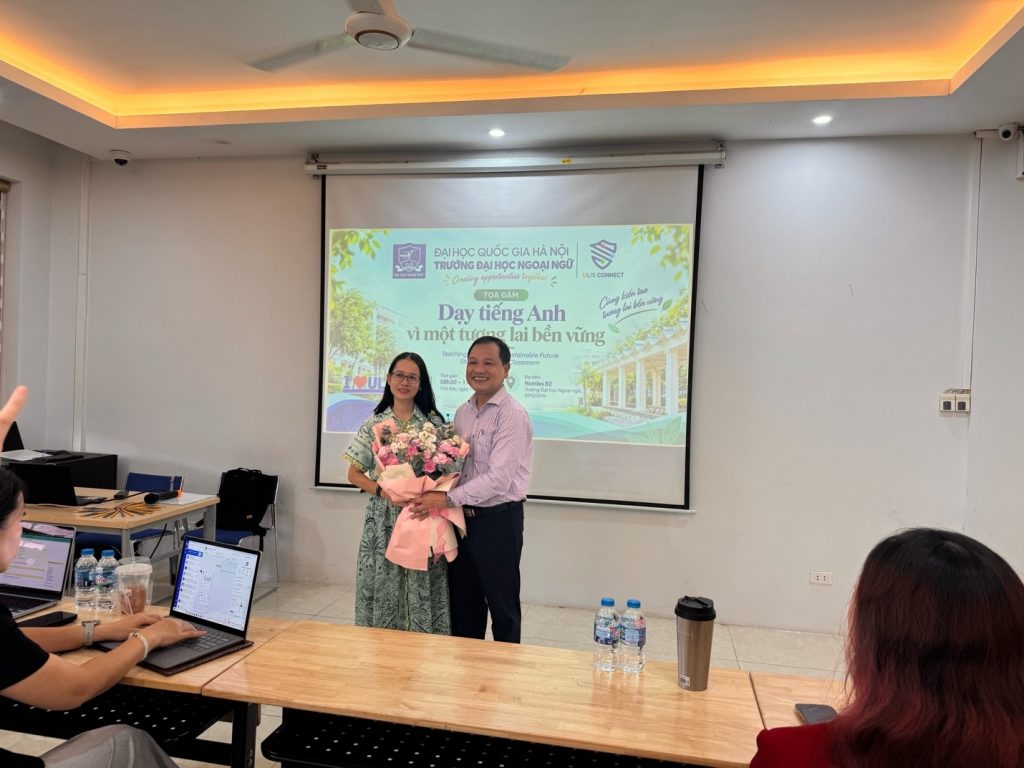
From there, the story of a concept that seems so broad – “sustainability” – was brought back to a very familiar space: the English classroom.
From “sustainability” to a broader view of education
At the start of the professional content, participants pondered a seemingly simple question: “What is sustainability?”
From dictionary definitions, the concept of sustainability was expanded in the context of English Language Teaching (ELT). Sustainability is not only linked to the environment, climate change, or nature conservation but also encompasses issues related to people – society and the economy. These three dimensions do not exist in isolation but are interconnected and mutually influential on the journey toward a sustainable future.
From that approach, the program introduced the 17 Sustainable Development Goals (SDGs) adopted by the United Nations in the 2030 Agenda. One point particularly emphasized was the close relationship between the goals: an environmental issue can simultaneously relate to health, education, equality, livelihoods, or quality of life.
More importantly for teachers: How can these issues enter the English classroom?
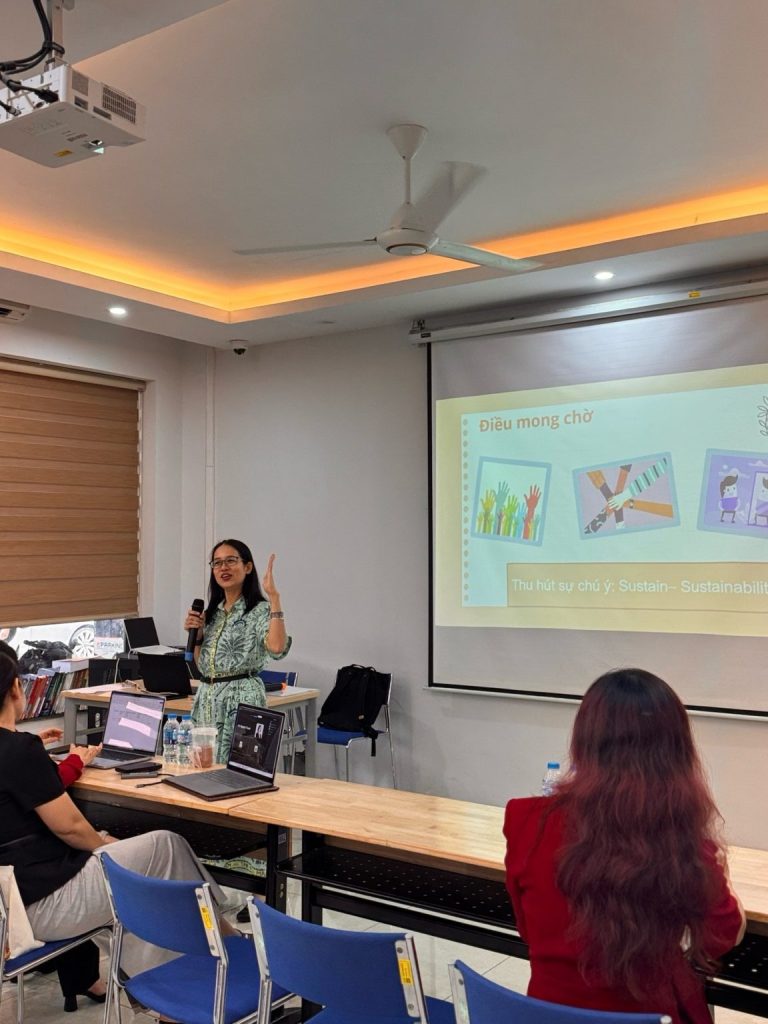
When English Is Not Only a Goal, but Also a Means to Understand the World
The seminar highlighted many reasons to integrate sustainability into English language teaching. Topics close to everyday life create opportunities for learners to use English for practical and meaningful purposes, rather than simply practicing the language in situations disconnected from reality.
When discussing the environment, community, people, or the challenges of contemporary society, learners have the chance to ask questions, express opinions, listen to different perspectives, cooperate, and search for solutions together. Through this, the lesson can simultaneously nurture interest and motivation to learn; critical thinking, creativity, and problem-solving; communication and collaboration skills, while also creating clearer connections between learning and life.
In particular, education for sustainable development can take learners through an important process: from awareness to reflection and toward action.
In this way, learners do not only learn English; they can also use English to understand, discuss and engage with the world around them.
Framework as a “Lens” for Looking Back at the Lesson
One of the program’s key contents was the introduction and practice of the Cambridge Framework for Sustainability in English Language Teaching and its accompanying Activity Cards.
A notable point was that the Framework was not introduced as a rigid set of criteria that teachers must try to “fit everything” into their lessons. Instead, the framework can be used as a lens through which teachers review content already present in the curriculum and textbooks.
A lesson on water, food, home, jobs, travel, technology, or community can all contain touchpoints with sustainability. From those touchpoints, teachers can add a question, extend a task, change the approach to a topic, or design a sequence of activities to help learners think more deeply.
Through concrete examples from general English textbooks, participants were guided to use the Framework and Activity Cards to adapt, extend, design new activities, or build new activity sequences, while still ensuring the language aims of the lesson.
The overarching message was very clear: integration does not mean adding more content to the lesson.
Learning Through Experience, Understanding Through Practice
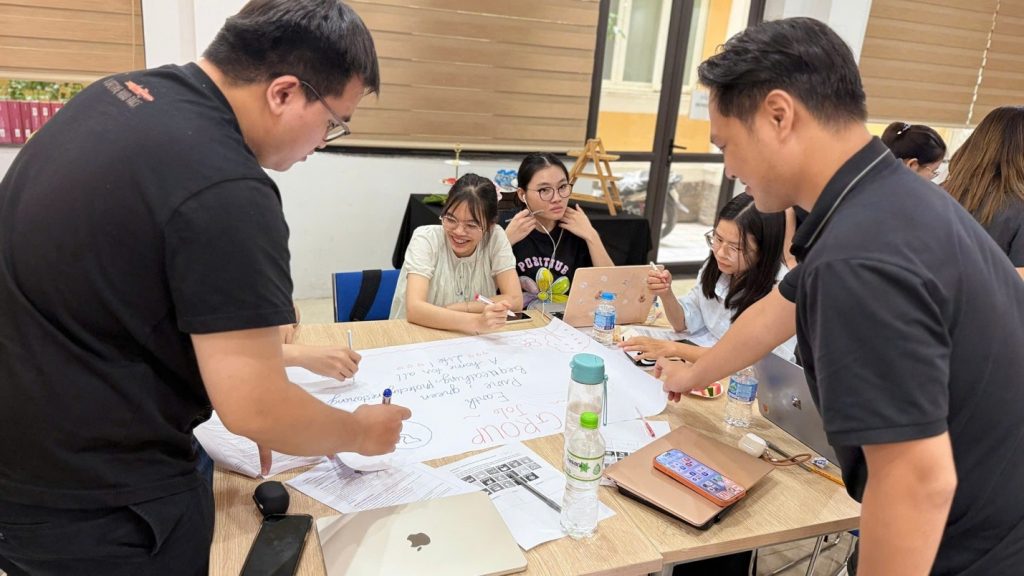
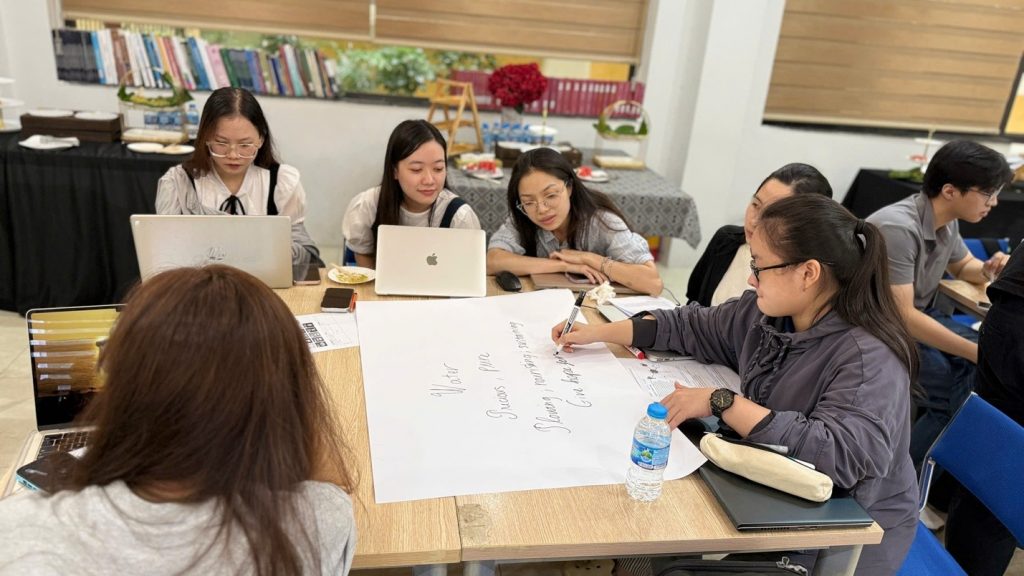
The spirit of “learning by doing” was maintained throughout the seminar. Instead of only listening to presentations, participants continuously worked in groups, exchanged ideas, analyzed, created, and directly experienced activities that could be used in the classroom.
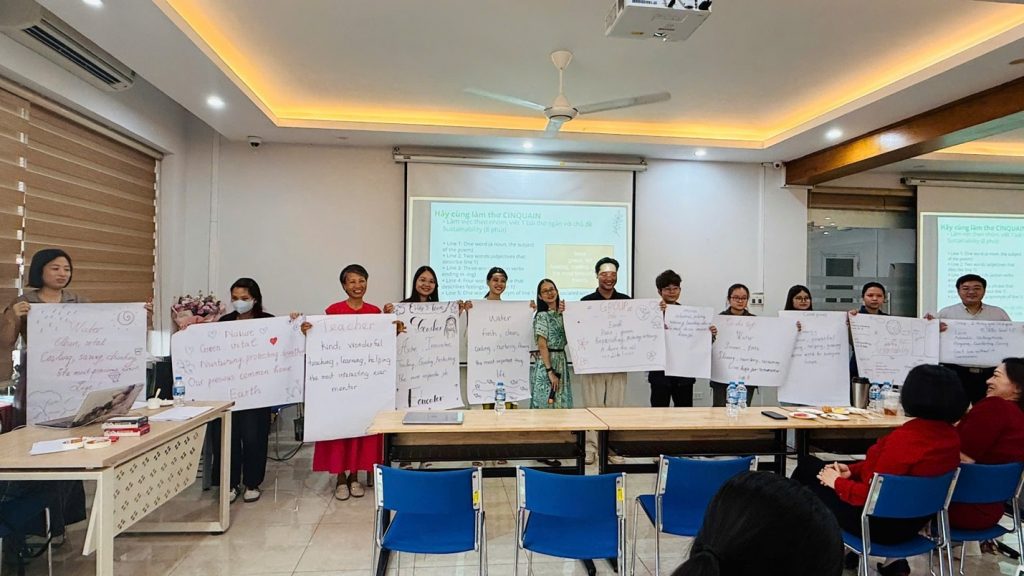
One of the most engaging activities was a challenge to write cinquain poems around the theme of sustainability. From keywords such as Nature, Water, Earth, and Teacher, groups chose language together, discussed meaning, expressed viewpoints, and created their own products.
Large sheets of paper were quickly filled with words, images, and ideas. Nature appeared with “green,” “vital,” and “nurturing”; Water was linked with “fresh,” “clean,” and “flowing”; Earth became “our precious common home”; and the image of the teacher was connected with keywords such as “active,” “innovative,” “teaching,” “guiding,” and “reflecting.”
That very process showed that sustainability does not necessarily have to be conveyed through lectures heavy with knowledge. A familiar language activity, if designed with an appropriate purpose, can become a space for learners to use English, collaborate, create, and at the same time reflect on larger values.
What Participants Took Away After a Morning
After the experiential and hands-on sessions, the program’s key messages gradually came together into an approach that was relatively simple yet practical for teachers.
It means broadening perspectives on sustainability beyond the environmental sphere; recognizing sustainability potential within existing lessons; and using the Framework as a “lens” rather than a mandatory template.
It is also the principle of “Adapt – Extend – Do Not Overload the Lesson.” Teachers do not necessarily have to create a completely new lesson. A changed question, an extended task, or an issue connected more closely to life is sometimes enough to make a difference.
More important than anything is balance: the goal of developing English proficiency and the goal of educating for sustainability need to go hand in hand and support each other, rather than competing for time.
From Today’s Classroom to a Sustainable Future
The seminar concluded with a sharing and Q&A session, where participants looked back on what they had discovered, exchanged questions from their teaching practice, and shared how they could apply the ideas in their own classrooms.
But perhaps what remains after the program is not only a Framework, a set of Activity Cards, or a list of SDGs.
It is also a different way of looking at the role of the foreign language classroom.
A sustainable future does not necessarily have to begin with grand things. For teachers, it can begin with a lesson, a question, a discussion, a small activity – and from today’s classroom itself.
At that point, teaching English is not only about helping learners use another language. It can also be a journey that helps them understand themselves better, connect with the community, see the wider world, and realize that they too have a role in shaping the future.
Teaching English for a Sustainable Future – Starting from the Classroom.
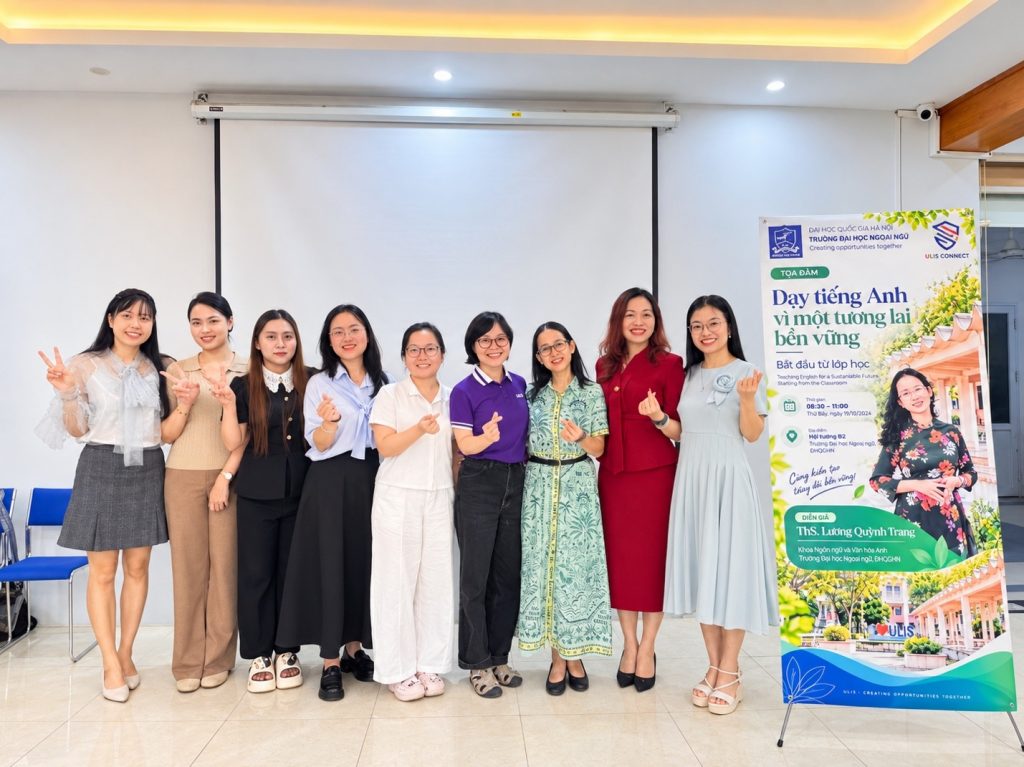

Nguyễn Hằng Nga/ĐSTT
