
Blue Waves Media Contest is an annual contest for the making of media works about the lives, learning journeys, and coming-of-age experiences of students in the Transnational Cultural and Media Studies program, Faculty of English Language and Culture, ULIS. By 2026, the first cohort of students is preparing to enter their final year. (The program began admitting students in the 2023–2024 academic year; more information about the curriculum is available here: https://bit.ly/3xhYhiR). Meanwhile, first-year students are preparing to welcome a new cohort.
After three seasons, Blue Waves has become more than a space where students practise storytelling, image-making, and experiment with forms of media expression. The contest has grown into a space where students look back on their own journeys: from the uncertainty of choosing a program of study, through the encounters and frictions of growing up, to the effort to find their own voice and their own way of telling stories.
This article introduces a number of award-winning works from Blue Waves Media Contest 2026. It also shares reflections from the Jury on the meaning of the contest as an experiential activity within the Transnational Cultural and Media Studies program. Through these works, one can see more clearly an important spirit of the field: media is not merely a matter of producing content; it is also a capacity to perceive, to think, to listen to life, and to give form to what is meaningful to human beings.
From Personal Narratives to Media Works
Below is the speech delivered by Dr. Phùng Hà Thanh, Vice Dean of the Faculty of English Language and Culture and Head of the Jury, at the Blue Waves Media Contest 2026 Award Ceremony on 17 May 2026.
“I am one of the people in charge of media work for the Transnational Cultural and Media Studies program. In the process of introducing the program, I have had the chance to meet quite a few people ‘from the outside’: people who have read about the program on the Transnational Cultural and Media Studies – Division of International Studies page, on the University’s website, and who have watched works from Blue Waves Media Contest, a media contest about the lives, academic experiences, and paths of self-formation of students in Transnational Cultural and Media Studies.
And yet, I found it striking that many people, even after watching these works, still wanted something more: to ask ‘real people’ directly, to hear the stories confirmed in living voices. There is, of course, nothing wrong with such a need.
But it did give me a slight shock. As someone inside the program, I had thought very simply: when a media work contains students’ voices, then those voices are real. Surely they could not be false. I truly go out to collect and receive students’ voices. But when students share things with me, are they telling the truth? Do I trust them too much?
Let me say this clearly: I believe the students. I do not believe them blindly; I believe them because we work with them, listen to them, and accompany them in their process. Today, I would like to share just one small example. In the process of judging and giving feedback on the submissions, we encountered works that were almost like confessions. The students told their stories very directly and sincerely, as if they were speaking to teachers, to friends, to people who were directly connected to their stories. At those moments, what we needed to do was help them take one further step: from personal confession to media work.
When a story is brought before the public, it is no longer merely a narrative within a direct relationship. It becomes a work presented to people who were not necessarily present in the original situation, who do not necessarily know the characters, and who do not necessarily share the storyteller’s context. That story needs to find a form of expression.
This is very different from hiding the truth. It is also very different from making the story less truthful. On the contrary, it is precisely through form that truthfulness can become more subtle, more profound. A work does not simply recount what has happened. It helps us understand why what happens matters; why it moves people, changes them, wounds them, helps them grow, or allows them to see the world differently.
In this contest, I believe that truthfulness is the most important element. In the context of media-making, truthfulness should not be understood simply as direct telling. Truthfulness in a media work requires more than that. It requires the maker to know how to select, organize, listen to their own experience, and find an appropriate form of expression so that human feelings and perceptions can appear in all their complexity and delicacy.
That is also why I believe Blue Waves is not only a contest for making media products. If we call them merely ‘products,’ we may easily think of something made to serve a process, a requirement, or some industrial objective. But what you are doing here, to my mind, is closer to the making of works: creative forms marked by personal voice, thought, emotion, aesthetic choice, and responsibility toward the story being told.
This contest hopes to help students understand that media practice is not merely the skill of producing content. It is also a capacity to perceive, to think, to mediate, and to express.
In a moment, we will watch the selected works screened this year. I hope that as we watch them, we will not only ask what stories the students have told, but also pay attention to how they have searched for forms through which to tell those stories. What is precious is not only personal self-disclosure, but also the creative effort to give those personal stories shape, depth, and the capacity to encounter others.”
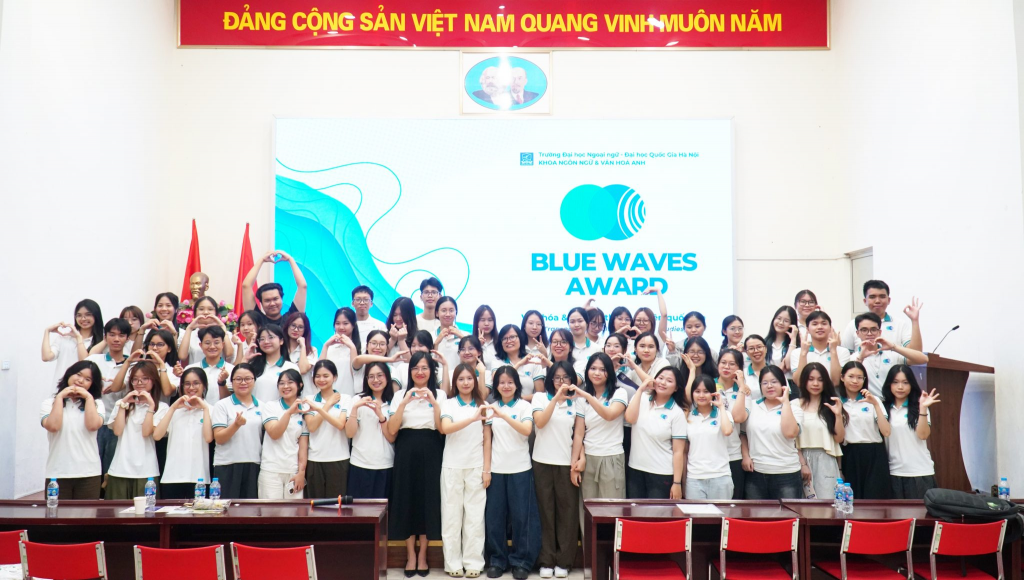
The Blue Waves Media Contest 2026 Award Ceremony took place on 17 May 2026 at Vũ Đình Liên Hall.
Selected Award-Winning Works

Finding Myself Again
Nguyễn Minh Huệ, 25VH1
Spotlight Award, Blue Waves Media Contest 2026
“From my initial thinking, I chose media as the field I wanted to pursue in the future. At first, I only knew about media-related programs at the Academy of Journalism and Communication or the Diplomatic Academy of Vietnam. But after much consideration, I realized that I was not truly suited to political communication or entertainment media. I wanted a field of media studies and practice that was meaningful and profound, yet still close to life. After weeks of searching, I accidentally came across the Transnational Cultural and Media Studies program at the University of Languages and International Studies, Vietnam National University, Hanoi.”
~ Nguyễn Minh Huệ, 25VH1
Nguyễn Minh Huệ’s work, which won the Spotlight Award at Blue Waves Media Contest 2026, offers a sincere and compelling account of how she came to choose her field of study. Its apparent simplicity carries the weight of a young person learning to recognize what does and does not fit her, and gradually claiming a path of her own. Moving from an option once considered highly desirable to a field in which she could find both intellectual and personal resonance, the work does more than recount an individual decision. It turns that decision into a reflection on self-formation, educational choice, and the right to come into one’s own.
Huệ’s story speaks meaningfully to many young people standing before similar choices. It invites them to see the differences among current directions in culture, media, and communication within Vietnamese higher education, and to recognize the courage it takes to choose an environment that helps one understand not only the world, but also oneself.
Gathering Sunlight, Becoming Myself
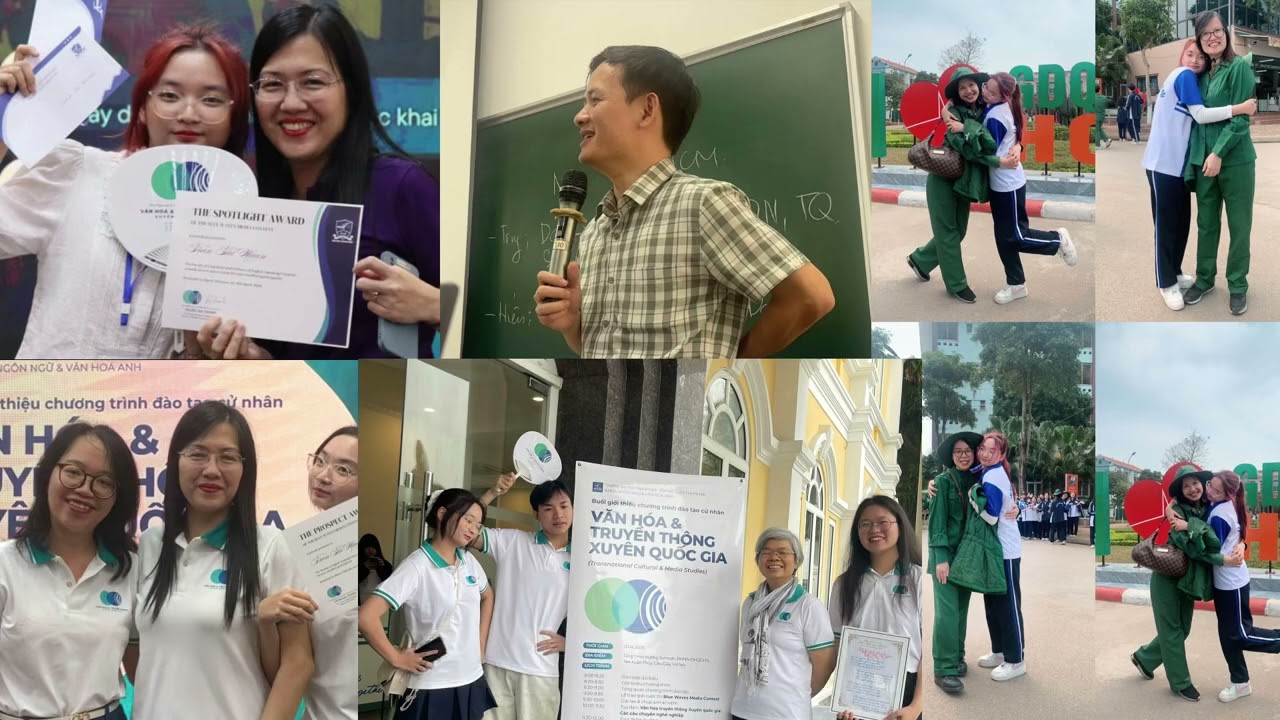
Trần Thị Nhàn, 23VH2
Inspiration Award, Blue Waves Media Contest 2026
“The sunlight falling at that moment seemed to turn me back toward myself and toward the academic year I had just lived through: a year of many emotional states, of tears shed in helplessness and worry, and tears shed in happiness. I felt that these moments needed to be preserved in some special way; otherwise, they would slowly fade, like the last streaks of sunlight at the end of the day.
And so I began to write down my journey, search for old photographs, and gather fragments of memory for Gathering Sunlight, Becoming Myself. This work is not simply a video about achievements or milestones in an academic year. It is my way of gathering the small rays of sunlight along my own path of becoming: the joys, the sorrows, the times I stumbled, and the moments I shone, so that I could see how all of them have helped shape the singular version of myself that I am today.”
~ Trần Thị Nhàn, 23VH2
Returning Home
Lô Văn Tý, 23VH2
Inspiration Award, Blue Waves Media Contest 2026
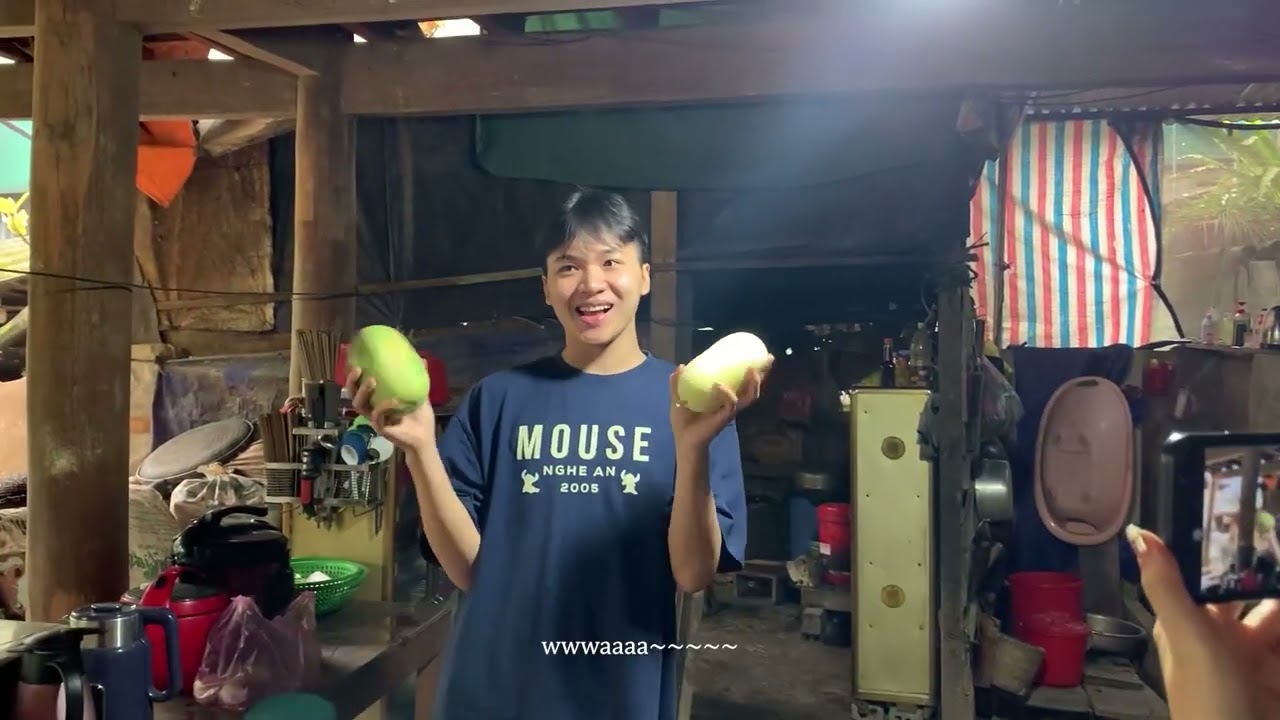
“It was a hurried trip before Tết 2026. I saw it as a rare chance to return home after things that had been, for me, so painful that I had never wanted to go back. I told myself to think of it simply as a field trip, a chance to observe for a course. Having friends and teachers with me gave me courage, although the return continued to haunt me and left me sleepless for more than a week.
I had not planned to film anything, or to do much beyond taking in the atmosphere of return. Most of the clips were filmed by others; only later did I decide to gather them into a work for Blue Waves 2026.
At first, I imagined the video as something like a travel vlog. I spent several days working things out and eventually pieced together a fairly complete version. But while editing the final moments of the trip, I heard my old name — ‘Cà’ — spoken by Grandpa Tím as he gave me his parting words. He was the person who made me decide to open up about that name, and about a small life, rather than simply make a vlog about a trip.”
~ Lô Văn Tý, 23VH2

Mi Tells the Story of Sen
Trương Mỹ Hà, 23VH2
Inspiration Award, Blue Waves Media Contest 2026
“The idea for this work came to me from videos by the YouTuber Cận Thị. At first, I watched Cận Thị’s videos simply as background sound while studying or relaxing. The videos often revolve around very small, everyday stories, yet they are connected to the memories of many people, myself included: from ranking how delicious different kinds of snacks are to a question that seems simple, such as which brand of bottled water tastes best.
I especially love the way he tells ordinary stories in a humorous and approachable voice. Through that, I also found a sense of resonance with my own sometimes clumsy learning experiences, and I realized that many people must have gone through similar things.
What impresses me most about Cận Thị is his distinctive storytelling style: simple hand-drawn animated characters, with colors that feel somewhat naive and scribbled, yet placed within carefully crafted and highly creative frames. However, for someone like me, who had almost no background in drawing or animation, making a work in this style was no small challenge.
I began teaching myself animation through online tutorial videos and learned how to use Adobe Animate. But just as I was becoming familiar with the software, I encountered another obstacle: drawing with a mouse was too difficult, while I did not yet have a drawing tablet. Because of that, the project had to be put on hold for a while before Tết.
After Tết, I decided to return to the project, after saving enough money to buy an iPad. Even then, the process was far from easy. I had to get used to a completely new application and relearn almost everything from the beginning. Because of the limitations of my equipment and my personal skills, I chose the most traditional method of animation: drawing each frame by hand to create movement. To make one minute of video took me about four days, around four hours each day.
Perhaps the most memorable moment was the final day before the submission deadline. The next morning, I had to give a presentation for a course project at school, so the night before I had stayed up until midnight preparing for it. After finishing that work, I continued editing the sound and completing the final details of my piece until 3 a.m. It was a rather exhausting night, as I had to make sure the group project for the next day was ready while also finding suitable sound for the video.
Looking back on the whole process, this project gave me the opportunity to try my hand at a completely new field, to persist through limitations in both skills and equipment, and to transform a very everyday source of inspiration into a work bearing my own personal mark.”
~ Trương Mỹ Hà, 23VH2